
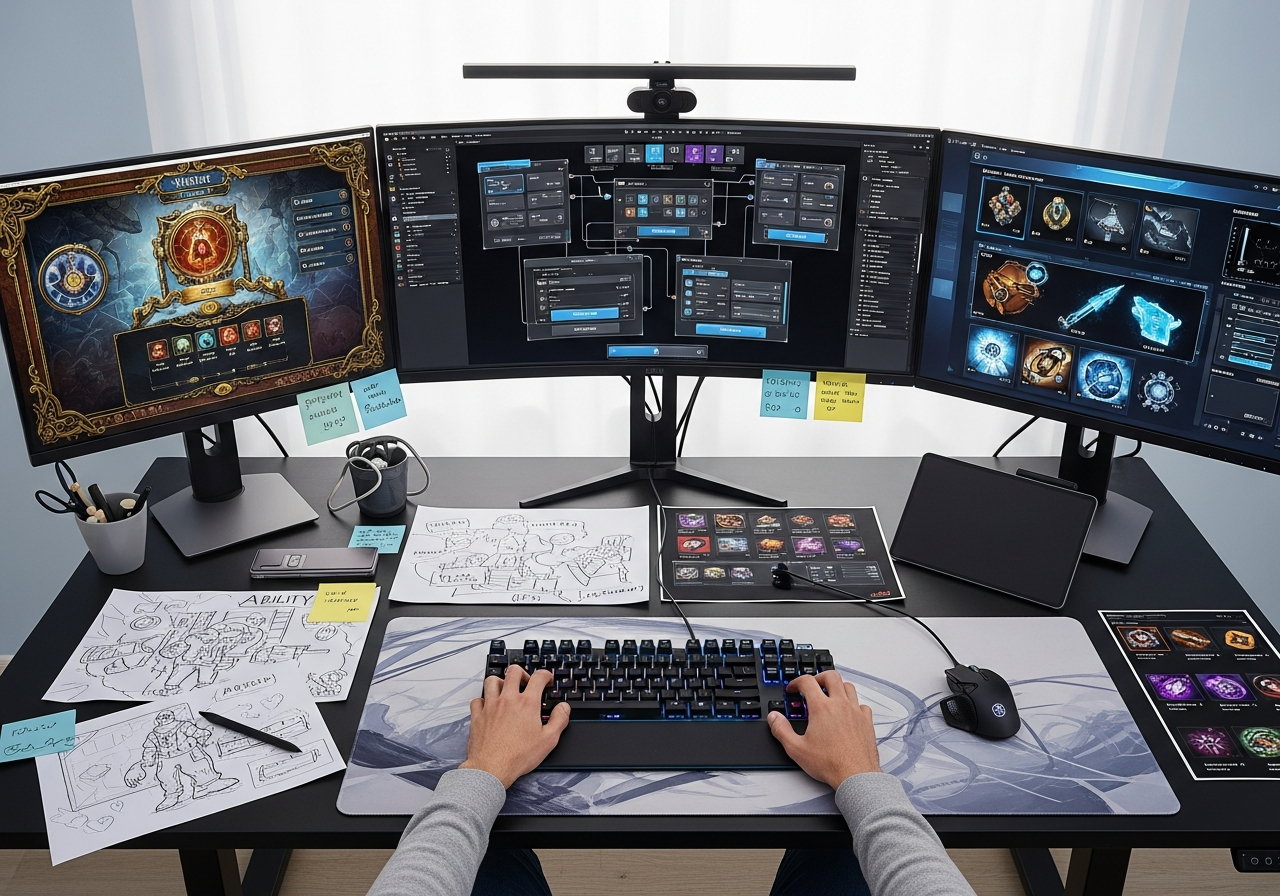
Canadian game studios and game-adjacent employers approach UI/UX portfolio screening differently than traditional tech companies. While generic UX portfolios often emphasize business metrics and conversion optimization, game employers prioritize player-centered problem solving, clear design process documentation, and measurable impact on player experience. The strongest portfolios demonstrate how designers think through complex player interactions, iterate based on playtesting feedback, and collaborate effectively within game development constraints.
This recruiter-focused breakdown reveals the specific hiring signals Canadian game employers actually screen for, the portfolio structure that gets candidates shortlisted, and the evidence that proves fit for game teams. Understanding these employer expectations transforms a standard UX portfolio into an interview-ready showcase that speaks directly to game studio hiring priorities.
What Canadian Game Employers Actually Screen For
Game studios evaluate portfolios through a fundamentally different lens than traditional UX employers. They seek evidence of player psychology understanding, collaborative game development experience, and the ability to balance player needs with technical constraints. Canadian employers particularly value candidates who can demonstrate experience across multiple platforms and game genres.
The screening process focuses on identifying designers who understand that game UI serves the player experience first, business goals second. Employers look for evidence of iterative design thinking, player research integration, and the ability to communicate design decisions within cross-functional game teams.
| Signal | Why it matters | How it appears in a portfolio |
|---|---|---|
| Player-centered problem solving | Shows understanding of game mechanics and player psychology | Case studies explaining player pain points and design solutions |
| Iterative design process | Games require constant refinement based on player feedback | Before/after comparisons with testing insights and iteration rationale |
| Cross-platform experience | Canadian studios develop for mobile, PC, and console simultaneously | Projects showing responsive design across different screen sizes and input methods |
| Collaboration evidence | Game development requires tight coordination with artists, programmers, and designers | Clear role definitions and team workflow descriptions in case studies |
| Technical constraint awareness | Game UI must work within performance and memory limitations | Design decisions that balance visual appeal with technical feasibility |
| Player research integration | Data-driven design decisions improve player retention and engagement | Research findings directly influencing design choices with supporting evidence |
These screening priorities reflect the unique challenges of game development, where player experience directly impacts retention, monetization, and studio success.
Core hiring signals vs. generic UX expectations
Traditional UX hiring emphasizes business impact metrics, conversion optimization, and stakeholder management. Game studios instead prioritize player engagement metrics, retention data, and collaborative development skills. The fundamental difference lies in serving players versus serving business stakeholders as the primary user group.
Generic UX portfolios often showcase marketing websites, enterprise software, or e-commerce platforms. Game employers need evidence of interactive entertainment design thinking, including understanding of player motivation, game flow, and the balance between challenge and accessibility.
Canadian game studios particularly value candidates who demonstrate knowledge of local market preferences, platform distribution nuances, and regulatory considerations that impact game UI design across different regions and age ratings.
Portfolio evidence that proves fit for game teams
Strong game portfolio evidence includes wireframes showing information hierarchy for complex game systems, prototypes demonstrating interaction design for player feedback loops, and final designs that clearly communicate game mechanics through visual design. Each piece should connect design decisions to player experience outcomes.
Collaboration evidence appears through detailed role descriptions, team workflow explanations, and clear attribution of individual contributions within larger projects. Employers need to understand how candidates work within the creative constraints and technical limitations inherent in game development.
Technical awareness shows through design systems that account for localization needs, accessibility considerations across different player abilities, and performance optimization discussions that balance visual quality with technical requirements.
Portfolio Structure That Canadian Recruiters Can Scan Fast
Canadian game recruiters typically spend 90 seconds on initial portfolio reviews, making scannability crucial for advancing to interview stages. The most effective portfolios feature 2-4 featured projects with clear navigation, concise introductions, and immediately visible highlights of relevant game experience. Visual hierarchy should guide reviewers directly to the most compelling work.
Successful portfolios eliminate friction through fast loading times, mobile responsiveness, and intuitive navigation that doesn’t require explanation. Each section should serve a specific purpose in the hiring evaluation, with redundant or weak content removed to maintain focus on standout work.
- Homepage featuring 3-4 best projects with clear thumbnails and one-sentence descriptions
- Brief professional summary (2-3 sentences) highlighting game experience and key skills
- Dedicated case study pages with consistent formatting and clear problem-solution structure
- Skills section organized by game-specific competencies rather than generic UX categories
- Contact information and availability prominently displayed on every page
- Optional about section kept to essential professional background without personal details
This structure allows recruiters to quickly assess portfolio quality, identify relevant experience, and determine interview fit within their limited review time. Each element supports the rapid decision-making process that characterizes initial portfolio screening.
Recommended portfolio sections and order
The ideal portfolio opens with featured work that immediately demonstrates game UI/UX competency, followed by detailed case studies that reveal design thinking and process. The about section should focus on professional background relevant to game development, while contact information needs prominent placement for easy follow-up.
Navigation should follow conventional patterns that don’t require learning, with section names that clearly indicate content. The homepage serves as a filtering mechanism, allowing recruiters to quickly identify candidates with relevant experience before investing time in detailed case study review.
Optional sections like testimonials, additional work samples, or detailed skill breakdowns should only appear if they strengthen the core narrative. Every portfolio element should either demonstrate game UI/UX competency or support the candidate’s professional story.
The Case Study Format Employers Trust
Game employers trust case studies that reveal design thinking process rather than just showcasing polished final screens. The most effective format follows a problem-solution-outcome framework that includes role clarification, project constraints, design process transparency, iteration examples, and measurable results. This structure allows hiring managers to evaluate both design skills and collaborative work style.
Each case study should tell a complete story from initial challenge through final implementation, with clear explanations of design decisions and their rationale. Employers particularly value seeing how candidates handle feedback, iterate based on user testing, and balance competing requirements within game development constraints.
| Case study part | What to include | Employer payoff |
|---|---|---|
| Problem definition | Player pain points, business context, technical constraints | Shows analytical thinking and problem framing skills |
| Role and responsibilities | Individual contributions, team structure, timeline | Clarifies collaboration style and individual capabilities |
| Design process | Research methods, ideation, wireframing, prototyping | Reveals methodology and systematic approach to design challenges |
| Iteration examples | Testing insights, feedback integration, design refinements | Demonstrates adaptability and user-centered design commitment |
| Final solution | Key screens, interaction flows, design system components | Shows execution quality and attention to implementation details |
| Results and impact | Player metrics, team feedback, lessons learned | Validates design effectiveness and professional growth mindset |
The case study format should remain consistent across projects while allowing content flexibility to showcase different skills and project types. Each section contributes to building employer confidence in the candidate’s design capabilities and professional approach.
Strong case studies balance comprehensive process documentation with concise presentation, using visual elements to support rather than replace clear written explanations of design thinking and decision-making rationale.
Problem, role, process, and outcome
Problem sections should clearly articulate the player experience challenge, business context, and any technical or resource constraints that shaped the design approach. This foundation allows employers to understand the project complexity and evaluate solution appropriateness within those specific parameters.
Role clarification prevents confusion about individual contributions within team projects, helping employers assess collaboration skills and individual design capabilities. Clear timelines and responsibility breakdowns show project management awareness and professional communication skills.
Process documentation reveals systematic design thinking while outcome reporting demonstrates accountability for design decisions. Together, these elements create a complete picture of professional design practice that employers can evaluate against their team needs.
The most effective case studies integrate these components naturally rather than treating them as separate checklist items, creating a coherent narrative that showcases both design skills and professional communication abilities.
What to show in each stage of the design story
Early-stage documentation should include research findings, user persona development, and initial concept exploration that shows broad thinking before narrowing to specific solutions. This demonstrates strategic design thinking and player-centered problem-solving approach that employers value in game UI/UX roles.
Development stages benefit from showing wireframe evolution, prototype testing results, and design iteration rationale that reveals collaborative refinement and systematic improvement. Including rejected concepts with brief explanations shows thorough exploration and decision-making criteria.
Implementation stages should feature final designs alongside developer handoff materials, design system components, and post-launch refinements based on player feedback. This complete cycle demonstrates professional execution and ongoing optimization mindset.
Each stage should include sufficient detail for employer evaluation while maintaining narrative flow and visual interest through strategic use of images, diagrams, and formatting that supports rather than overwhelms the written content.
Game-Specific Skills Canadian Employers Want to See
Canadian game employers prioritize skills that directly impact player experience and team collaboration within game development workflows. These competencies go beyond generic UX abilities to include game mechanics understanding, platform-specific design knowledge, and technical implementation awareness that enables effective communication with programmers and artists.
The most valued skills combination includes HUD design clarity for complex information display, menu hierarchy organization for deep game systems, player onboarding design that teaches mechanics progressively, feedback system design that reinforces player actions, and accessibility implementation that serves diverse player needs across different platforms and abilities.
| Skill | Game context | Portfolio proof |
|---|---|---|
| HUD design | Information hierarchy for real-time gameplay decisions | Interface layouts showing critical vs. secondary information organization |
| Menu systems | Deep navigation for complex game feature access | Information architecture diagrams and navigation flow wireframes |
| Onboarding design | Progressive disclosure of game mechanics and controls | Tutorial flow documentation with learning curve considerations |
| Feedback systems | Visual and audio cues that reinforce player actions | Interaction design specifications with state changes and transitions |
| Accessibility design | Inclusive design for diverse player abilities and preferences | Design system documentation showing accessibility considerations and alternatives |
| Cross-platform optimization | Responsive design for mobile, PC, and console interfaces | Comparative designs showing adaptation across screen sizes and input methods |
| Monetization integration | Ethical implementation of purchase flows and progression systems | User flow diagrams balancing player value with business objectives |
| Live service design | Flexible systems supporting ongoing content and feature updates | Design system frameworks showing scalability and component modularity |
These skills reflect the practical reality of game development, where UI/UX designers must balance player engagement with technical constraints, platform requirements, and business objectives while maintaining focus on player experience quality.
Skills most often associated with game UI/UX roles
Game UI/UX roles consistently require wireframing skills for complex interface layouts, prototyping abilities that can demonstrate interaction design concepts to stakeholders, and visual design competency that aligns with art direction while maintaining usability standards. These foundational skills enable effective communication within multidisciplinary game development teams.
Information architecture expertise becomes crucial when organizing deep game systems with multiple interconnected features, while interaction design skills must account for different input methods across platforms and the immediate feedback requirements of real-time gameplay. User research capabilities need adaptation for playtesting environments and player behavior analysis.
Technical communication skills enable effective collaboration with programmers on implementation feasibility, while design system development ensures consistency across large game projects with multiple interface components and lengthy development cycles.
How to Show Research, Testing, and Iteration
Effective portfolio presentation of research, testing, and iteration requires careful balance between comprehensive documentation and digestible presentation that respects reviewer time constraints. The strongest portfolios include user research artifacts, playtesting documentation, and clear modification explanations that demonstrate systematic improvement based on player feedback.
Iteration evidence should avoid overwhelming readers while proving systematic design refinement and user-centered decision making. The key lies in selecting the most impactful examples that clearly show problem identification, solution development, testing validation, and design refinement based on findings.
- Document initial player research through surveys, interviews, or competitive analysis with key findings summarized
- Show wireframe or prototype testing setup with clear methodology and participant criteria
- Present testing insights through organized findings that directly connect to design changes
- Demonstrate iteration through before/after comparisons with brief rationale for each change
- Include post-launch metrics or feedback that validates design effectiveness where available
- Summarize lessons learned and how insights influenced future design approach
This systematic presentation builds employer confidence in analytical thinking and systematic design improvement while showing commitment to player-centered design practice that extends beyond initial concept development.
Research artifacts that matter in game UX
Game UX research artifacts should include player interviews focused on motivation and behavior patterns, surveys measuring satisfaction and usability across different game features, and playtesting notes that capture both quantitative metrics and qualitative observations about player interaction patterns. These materials demonstrate systematic approach to understanding player needs.
Journey mapping becomes particularly valuable in game contexts for showing player progression through complex systems, while personas should reflect gaming behavior patterns and platform preferences rather than generic demographic information. Competitive analysis should focus on interaction patterns and player experience rather than business features.
Screenshots and recordings from playtesting sessions provide powerful evidence when edited to highlight key moments of player confusion, success, or unexpected behavior that influenced design decisions. These visual research artifacts make abstract findings concrete and memorable for portfolio reviewers.
How to present iteration without overwhelming the reader
Effective iteration presentation uses side-by-side comparisons with focused explanations that highlight specific changes and their rationale rather than comprehensive lists of every modification. Each iteration example should tell a clear story about problem identification, solution development, and validation that builds understanding of design thinking process.
Visual formatting should guide attention to key changes through highlighting, annotations, or progressive disclosure that allows readers to engage with varying levels of detail based on their time constraints and interest. Written explanations should focus on design reasoning rather than describing visual changes that readers can observe directly.
The most compelling iteration examples show meaningful player experience improvements rather than minor visual adjustments, helping employers understand the candidate’s ability to identify and solve significant usability problems through systematic testing and refinement.
Visual Quality, Personal Brand, and Portfolio Usability
Portfolio visual quality, consistency, and usability serve as direct samples of a candidate’s UX design judgment, making the portfolio experience itself a crucial hiring signal. Canadian game employers evaluate typography choices, navigation design, information architecture, and overall visual polish as indicators of professional design standards and attention to detail that will transfer to game projects.
The portfolio should demonstrate systematic design thinking through consistent layout patterns, clear visual hierarchy, and intuitive navigation that doesn’t require explanation or learning. Visual design choices should support content accessibility rather than creating barriers, while maintaining sufficient polish to reflect professional standards appropriate for game development teams.
Personal branding should emerge through design choices and content curation rather than explicit self-promotion, showing design sensibility and professional communication skills that contribute to effective team collaboration. The portfolio functions as both content delivery system and design sample, requiring balance between showcase functionality and visual appeal.
Technical execution matters significantly, as slow loading times, broken responsive design, or poor mobile experience immediately signal poor UX judgment to employers who expect candidates to apply usability principles to their own professional materials. Every aspect of the portfolio experience should reinforce rather than undermine the candidate’s design competency claims.
Why the portfolio experience is itself a hiring signal
Poor portfolio navigation, unclear information architecture, or inconsistent visual design immediately undermines even strong project work by demonstrating poor UX judgment applied to the candidate’s own professional materials. Employers rightfully question whether someone who can’t create a usable portfolio can effectively design game interfaces.
Conversely, portfolios that demonstrate clear information hierarchy, intuitive navigation, and thoughtful responsive design across devices show practical application of UX principles and attention to user needs that directly translates to professional game development work. The portfolio experience becomes evidence of systematic UX thinking.
Technical details like fast loading times, accessibility considerations, and cross-browser compatibility show professional standards and technical awareness that support effective collaboration with developers on implementation requirements and constraints within game development workflows.
How Canadian Game Employers Differentiate Strong From Weak Portfolios
Canadian game employers use specific comparison criteria to differentiate between interview-worthy portfolios and those that get filtered out during initial screening. Strong portfolios demonstrate clear game industry understanding, systematic design process, and measurable impact on player experience, while weak portfolios show generic UX work without game context or fail to communicate individual contributions within team projects.
The differentiation process focuses on identifying candidates who understand player psychology, can work within technical constraints, and contribute effectively to collaborative game development. Employers particularly notice portfolios that show iteration based on player feedback versus those presenting only final polished designs without process context.
| Strong signal | Weak signal | Hiring impact |
|---|---|---|
| 2-4 detailed case studies with clear problem-solution structure | 6+ shallow project descriptions without process detail | Strong: interview likely. Weak: filtered out immediately |
| Player metrics and feedback integration shown | No evidence of user testing or iteration | Strong: validates user-centered approach. Weak: suggests design-by-opinion |
| Clear individual role and contribution statements | Vague team project descriptions without role clarification | Strong: enables skill assessment. Weak: creates confusion about capabilities |
| Game-specific UI examples (HUD, menus, onboarding) | Only web or mobile app interfaces shown | Strong: proves relevant experience. Weak: requires training investment |
| Technical constraint awareness in design decisions | Designs that ignore implementation feasibility | Strong: shows collaboration readiness. Weak: suggests unrealistic expectations |
| Concise writing with scannable formatting | Dense text blocks without visual hierarchy | Strong: respects reviewer time. Weak: gets skipped due to poor readability |
These differentiation criteria reflect the practical realities of game development hiring, where employers need to quickly identify candidates who can contribute effectively from the start rather than requiring extensive onboarding or training to understand game development workflows.
Common portfolio mistakes that reduce interview chances
The most damaging portfolio mistakes include presenting too many projects without sufficient depth, failing to clarify individual contributions within team projects, and showing only final polished designs without process documentation. These errors prevent employers from evaluating design thinking and collaboration capabilities effectively.
Technical presentation mistakes like slow loading times, broken responsive design, or poor mobile experience immediately signal poor UX judgment, while excessive text without visual hierarchy makes portfolios difficult to scan during quick review sessions. Generic UX work without game context raises questions about industry understanding and passion.
Weak case study structure that lacks clear problem definition, solution rationale, or measurable outcomes makes it impossible for employers to assess problem-solving capabilities and systematic design thinking that game development requires.
Traits of portfolios that move candidates forward
Interview-advancing portfolios consistently demonstrate player-centered problem solving with clear metrics and feedback integration, systematic design process that shows iteration and refinement, and effective communication of complex design decisions within team collaboration contexts. These elements build employer confidence in professional readiness.
Strong portfolios balance comprehensive process documentation with concise presentation that respects reviewer time constraints, using visual hierarchy and formatting to make key information scannable while providing deeper detail for interested readers. Technical execution quality reinforces rather than undermines design competency claims.
The most successful portfolios show genuine understanding of game development challenges through appropriate project selection, realistic constraint acknowledgment, and evidence of collaborative work style that fits team-based creative development environments.
A Practical Portfolio Blueprint for Canadian Game Applicants
This blueprint transforms the hiring insights into actionable steps for building interview-ready portfolios that speak directly to Canadian game employer priorities. The approach works for junior designers building their first game portfolio, career switchers from other UX fields, and experienced designers targeting Canadian game studios specifically.
Success requires systematic project selection, strategic case study development, and careful presentation optimization that balances comprehensive skill demonstration with recruiter-friendly scannability. Each step builds toward a cohesive portfolio that proves game development readiness rather than just general UX competency.
- Audit existing work to identify 2-4 projects with strongest game relevance or transferable player experience elements
- Develop detailed case studies using problem-solution-outcome structure with clear individual role definitions
- Create or redesign portfolio site with game industry visual branding and intuitive navigation structure
- Document design process including research methods, iteration examples, and measurable outcomes where available
- Optimize all content for mobile responsiveness and fast loading across different devices and connections
- Test portfolio navigation and readability with peers, incorporating feedback before launching
- Customize portfolio messaging and project selection for specific Canadian studios and role requirements
This systematic approach ensures every portfolio element supports the hiring goal while demonstrating the systematic thinking and attention to user needs that game employers value in UI/UX design candidates.
Step-by-step portfolio build plan
Begin by conducting competitive analysis of successful game UI/UX portfolios from Canadian designers, identifying common structural patterns and presentation approaches that resonate with local employers. This research phase should inform both content strategy and visual design direction for maximum alignment with industry expectations.
Project selection should prioritize quality over quantity, choosing work that demonstrates game-relevant skills even if not explicitly game projects. Mobile app onboarding, complex dashboard design, or interactive entertainment projects can translate effectively with proper contextualization and gaming industry language.
Case study development requires systematic documentation of design process, including research methodology, ideation approaches, iteration rationale, and outcome measurement that proves systematic design thinking rather than intuitive visual design alone. Each case study should build employer confidence in collaborative design capabilities.